Repair or Replace? A Practical Decision Framework for Southern Ontario Plant Managers
Every plant manager eventually faces the same question standing in front of a failed or failing pump: is this worth repairing, or is it time to replace it? Get the call wrong in either direction and it costs money — either in an unnecessary capital purchase, or in a pump that keeps coming back to the shop.
Here’s a practical framework we walk customers through across Hamilton, Halton, Niagara, Peel, and the rest of Southern Ontario.
Start With the 50% Rule — Then Look Deeper
A common industry rule of thumb: if the repair cost exceeds roughly 50% of the price of a new, equivalent pump, replacement starts to make more sense on cost alone. But that number is a starting point, not the whole answer — the real decision depends on four other factors.
1. What’s Actually Damaged
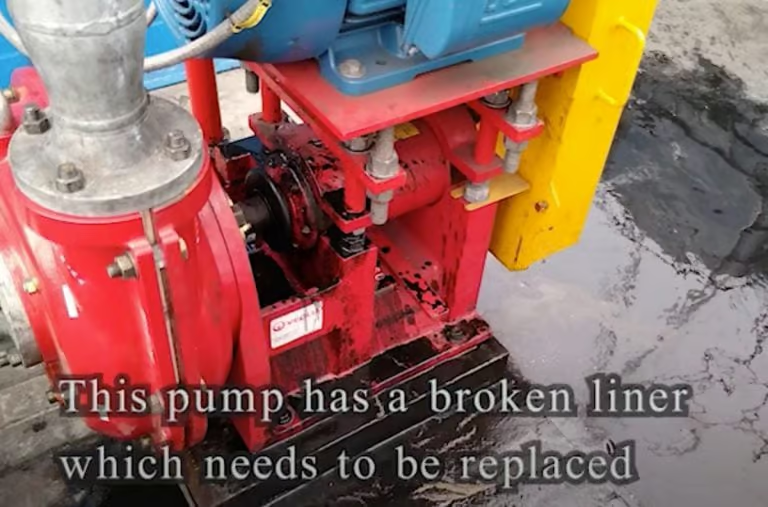
There’s a big difference between a worn mechanical seal and a cracked casing or a bent shaft. Seal, bearing, and impeller wear are routine, expected, and inexpensive to correct. Casing damage, shaft fatigue, or motor burnout are a different conversation — and worth a full inspection before quoting, rather than assuming based on symptoms alone.
2. How Many Times Has This Pump Already Been Repaired?
One repair in a pump’s life is normal. A pattern of repeat repairs — especially the same failure mode recurring — usually signals either a root-cause issue (misalignment, wrong pump for the application, cavitation) or a pump that has simply reached the end of its economic life. At that point, a repair addresses the symptom while leaving the underlying cost driver in place.
3. Has the Application Changed?
Pumps are selected for a specific duty point — flow, pressure, and fluid characteristics. If your process has changed since the original pump was installed (different throughput, different chemistry, more solids), the existing unit may be undersized or mismatched for current conditions no matter how well it’s repaired. In that case, replacement with a correctly sized pump often solves a problem that repeated repairs never will.
4. What Does Downtime Actually Cost You?
This is the number most plants underestimate. A pump that’s simple and fast to repair — even repeatedly — may still be the cheaper option if lead times on a replacement are long. Conversely, if a critical process pump has no redundancy, the cost of extended or repeat downtime can outweigh a higher upfront replacement cost many times over.
A Simple Way to Decide
| Factor | Leans Repair | Leans Replace |
|---|---|---|
| Damage type | Seal, bearing, wear parts | Cracked casing, bent shaft, motor burnout |
| Repair history | First or occasional repair | Repeated failures, same root cause |
| Application fit | Still correctly sized for the duty | Process demands have outgrown the pump |
| Repair cost vs. new pump | Well under 50% | Approaching or exceeding 50% |
| Downtime tolerance | Some downtime is workable | Zero tolerance, no redundancy |
Get an Honest Assessment, Not a Sales Pitch
The right call is different for every pump and every plant — and it should come from an actual inspection, not a guess over the phone. Industrial Pump Repair Canada has been repairing and rebuilding pumps across Southern Ontario for decades, and we’ll tell you plainly when a repair makes sense and when it doesn’t.
If you’re weighing repair vs. replace on a pump at your facility, request a quote or call 1-844-291-6609 — we’ll give you a straight answer.